You’re a few months into owning your practice. Patients are coming in. The schedule is starting to fill. Your team is finding its rhythm, and money is finally hitting the account.
Then someone asks, “How’s the practice doing?”
You probably have an answer ready. You might tell them how many new patients you saw last month or how much you collected. But later, after everyone has gone home, you look at the schedule for next week and the bills due after that. You’re busy. You’re making progress. You’re also wondering whether the practice is becoming stronger or whether you’re just working hard enough to keep it moving.
That uncertainty is normal. In the first year, every number seems to need an explanation. A great production day can make you feel like things are taking off. A few cancellations can make you question everything. An insurance payment lands and the bank balance looks healthy, but payroll, rent, and a loan payment are all coming out soon. One unusually large case can make a month look amazing even if the rest of the schedule is thin.
New patients are a good example. Every person who chooses your practice matters. But a new patient count tells you only that they arrived. It doesn’t tell you whether they had a good first experience, understood the care they need, scheduled an appropriate next visit, or will ever come back. You could keep bringing in new people while failing to build the patient base that will sustain the practice a year from now.
Production has a similar blind spot. It tells you what care was completed and recorded. It doesn’t mean every claim has been submitted correctly or that every balance has been paid. Collections get you closer to the money, but payments recorded in your software may not match what reached the bank that month. And money in the bank today doesn’t automatically mean you can comfortably afford another hire, more marketing, or an extra day of clinical hours.
None of those numbers is useless. They just answer different questions. The trouble starts when you ask one of them to answer, “Are we doing well?”
That’s what this scorecard is meant to change. Once a month, you’ll put eight numbers next to each other and follow the story they tell. Are people getting in the door? Are they scheduling the care and follow-up that make sense for them? Is the work you complete turning into payments? Are those payments reaching the bank? What does it cost to keep the practice running, how much cash breathing room do you have, and does your staffed schedule have room for the growth you’re trying to create?
You’re looking for the place where that story breaks. Maybe marketing is doing its job, but too many patients leave without a next appointment. Maybe the schedule is full, but old claims are piling up. Maybe collections are improving, yet fixed costs are rising faster than the practice can support. Each situation calls for a different move. Buying more ads, hiring another person, and working longer hours are expensive guesses if you haven’t found the actual problem.
There’s no single monthly number that proves a startup is on track. Your debt, team, hours, fees, payer mix, and personal cash needs are different from another owner’s. What you can do is compare this month with your plan and with the months before it. You can see what is improving, what is slipping, and what needs attention before it becomes a crisis.
The goal is to finish your monthly review with a sentence you can act on: “Here is the part of the practice that needs work, here is what we’re changing, and here is how we’ll know next month if it helped.”
Set up the scorecard once
Start by making every number mean the same thing each month
Use the calendar month as your reporting period. For each measure, show this month, prior month, year to date, and your plan in separate columns. Put the month and year at the top of the page. It sounds obvious, but “we had 30 new patients” means very little if nobody knows whether that was last month, the last 30 days, or since opening.
Next, decide exactly what you are counting. For this scorecard, a new patient is someone who completed their first visit. Someone who called or booked but never came in belongs in a separate count. A collection is a payment posted in your practice software. A bank deposit is money that actually settled in your account. Those last two numbers may differ for perfectly explainable reasons, which is why they have separate rows.
Write the definition beside each measure and keep the report settings the same. If you change how you count something, make a note on that month’s scorecard. Otherwise, a change in software settings can look like a change in the practice.
The American Dental Association recommends tracking a focused set of practice measures, including new patients, production, collections, appointments, and receivables. It also suggests looking at several months of data when available. That matters in a startup because one unusually large case or one late insurance payment can make a single month look stronger or weaker than it really was.
Put a plan beside the actual result
Your plan does not have to be perfect. It does need to be written down.
What did you expect to collect this month? How many staffed doctor and hygiene hours did you expect to offer? What fixed bills did you know were coming? What was your expected lowest cash balance? Put those expectations beside what actually happened. Then ask why the numbers differ.
For example, missing a collections goal could mean fewer patients came in. It could also mean production was on plan but claims are taking longer to pay. Those problems require different fixes. The scorecard should help you tell them apart.
Do not quietly rewrite the plan every time you miss it. Keep the original figure visible and date any revision. That way you can see whether the practice is changing or your assumptions are changing.
Give each number a source and a person who checks it
Most of these figures will come from different places. New patients, appointments, production, and posted payments usually come from the practice management system. Bank deposits come from the bank. Fixed commitments come from payroll, loan schedules, leases, and your bookkeeping records. Cash runway comes from a forecast you update as new information arrives.
Write down the report name or source for each line. Then assign someone to pull it and someone to review it. In a small startup, both people might be you. The point is to avoid spending your monthly meeting debating where a number came from instead of deciding what to do about it.
Record the eight measures

Add one sentence beside every result
The number tells you what changed. Your note should say what you think caused it.
“Collections fell” is a result. “Collections fell because two large insurance claims are still pending, while kept visits and production were on plan” is useful. It points toward a billing follow-up instead of an immediate change to marketing.
Keep the note short and specific. If you do not know why something moved, write “Cause unknown” and make finding out the next action. Do not fill the space with a guess that sounds convincing.
Read across the rows before making a decision
The real value of the scorecard comes from putting the numbers together. More new patients and weak recare booking might point to a problem at checkout. Rising production with flat collections might point to claim or payment delays. Strong collections with shrinking cash might point to rising commitments, debt payments, or purchases that the production report cannot show. A packed doctor schedule and an open hygiene schedule raise a different question from two schedules with plenty of room.
At the end of the review, choose one issue to investigate or fix first. Name the person responsible, the action, and when you will look again. Next month, you should be able to tell whether that action changed anything.
The goal is not a beautiful spreadsheet. It is a repeatable conversation with your own practice: What is working, where is the strain showing up, and what should we do next?
The collection-to-bank bridge
You have now looked at production, collections, and cash on the scorecard. Here is where many owners get stuck: the practice software says one amount was collected, but the bank shows a different amount deposited. Which number should you trust?
Start by remembering that the reports are tracking different moments. A payment can be posted to a patient’s account on Friday and settle in the bank on Monday. A card processor may deduct its fee before sending the deposit. One insurance EFT may cover several claims, and one bank credit may contain several days of card payments. A difference does not automatically mean money is missing. It does mean you need to explain it.
Begin with payments posted in the practice management system for the month. Separate them by card, insurance EFT, check, cash, patient financing, and any other payment type you use. Match each payment or settlement batch to a bank credit. For card payments, use the processor’s batch report to see which transactions were combined and whether fees, refunds, or chargebacks reduced the amount deposited. For insurance, use the remittance details to connect the EFT to the claims it paid.
Then account for payments that crossed the month boundary. Some payments posted last month may have reached the bank this month. Some posted this month may not arrive until next month. Record the actual batch and settlement date for each one. “Timing difference” is an explanation only when you can point to the payment and show when it settled.
This small bridge gives the owner a clean answer without turning the article into an accounting manual:
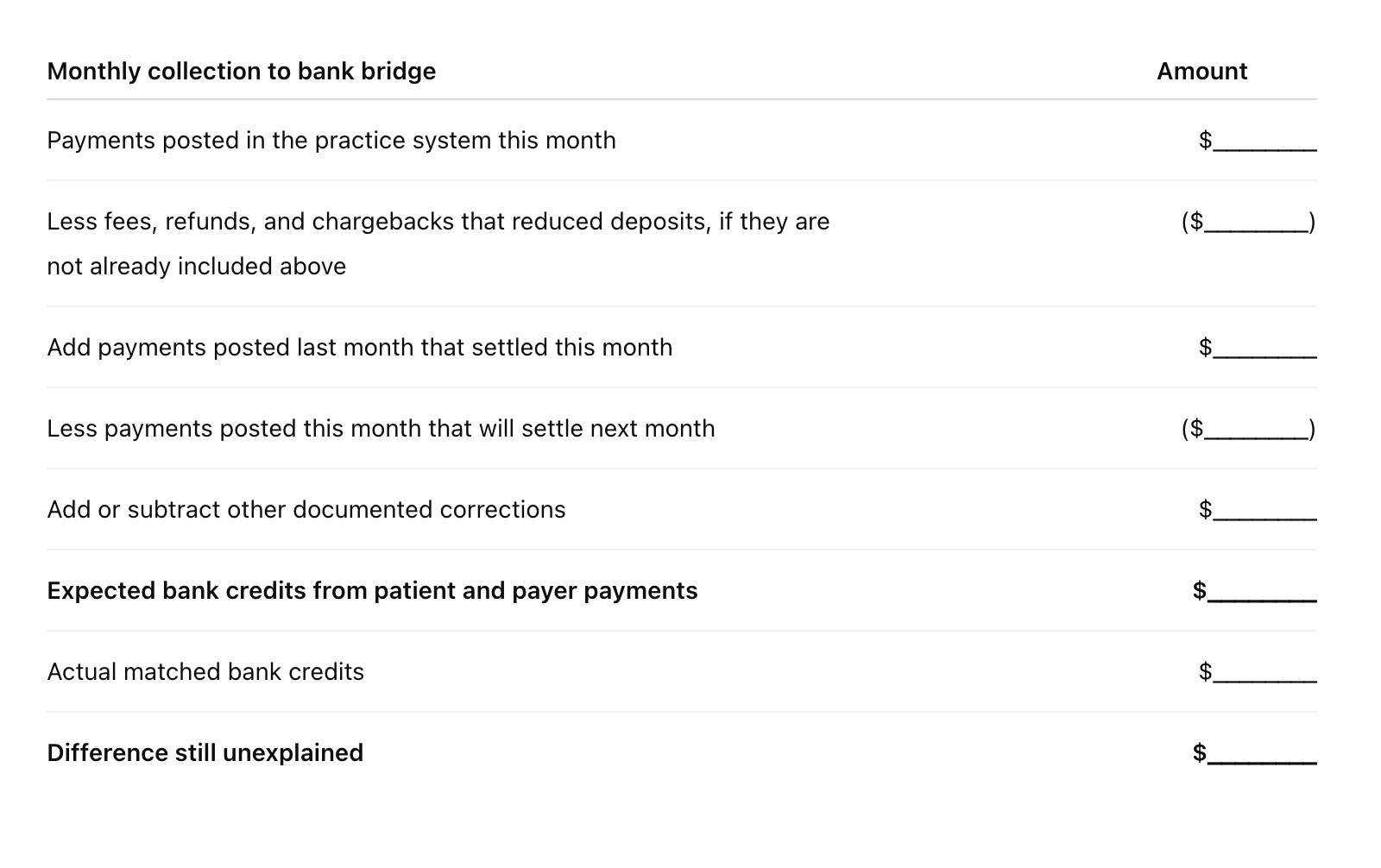
The qualification about refunds matters. If your collections report already subtracts a refund, do not subtract it again in the bridge. The same goes for fees: include a processing fee here only if it was withheld from the deposit. Your bookkeeper can confirm how the reports and accounting entries are set up.
Keep loan proceeds, owner funding, transfers between your own accounts, and tax refunds out of patient collections. They may appear in the bank, but they do not represent payment for care.
If the bridge leaves a difference, work backward from the unmatched bank credit or payment batch. Check the date, payment type, processor report, insurance remittance, and posting record. Give unresolved items an owner and a date for follow-up. The goal is not to make the difference disappear with a miscellaneous adjustment. The goal is to know where the money went.
This bridge is a cash receipts check, not a profit calculation. It tells you whether recorded payments became bank deposits. That gives you a more reliable cash number for the decision that comes next.
Turn a number into the next fix
Once the scorecard is filled in and the deposits make sense, resist the urge to work on everything at once. Read the numbers in an order that helps you find the most pressing problem.
- Make sure the practice can meet its next commitments. Look at the lowest projected cash balance over the next 13 weeks, especially around payroll, rent, debt payments, and large bills. If the cushion is getting thin, update the cash forecast before taking on another recurring expense.
- Follow completed work until it gets paid. If production is rising but collections are not, look at unsubmitted claims, rejected claims, old insurance balances, and patient balances. If collections are rising but bank deposits are unclear, use the bridge above. Give each aged balance or unmatched batch a person responsible for resolving it.
- See whether new patients are becoming returning patients. If first visits are increasing but few eligible patients have a next visit scheduled, find out what happens at checkout. Is there enough hygiene availability? Is the next step clear? Are patients choosing to wait? Review the reasons before changing the process, and keep clinical judgment ahead of a booking target.
- Check whether the schedule supports the growth you want. A full doctor schedule with open hygiene time calls for a different response than two open schedules. If both are consistently full and patients are waiting too long for appropriate care, model the cost and cash timing of adding staffed hours. If both have room, look at demand and how inquiries become kept appointments before adding capacity.
- Choose one move for the next month. Write down the problem, the action, who owns it, and what result would tell you it helped. You can still handle normal daily issues. This is the one improvement the team will deliberately work on and review next month.
Two practices can have similar new patient counts and collections and need completely different fixes. One may have patients returning, clean receivables, reconciled deposits, and a schedule that is nearly full. Its next decision could be about capacity. Another may have few return visits booked, aging claims, and a cash cushion that is getting smaller. Its first job is to repair those gaps.
That is the point of the scorecard. It does not hand you a grade. It helps you decide what deserves your attention next.
What a filled in scorecard actually tells you
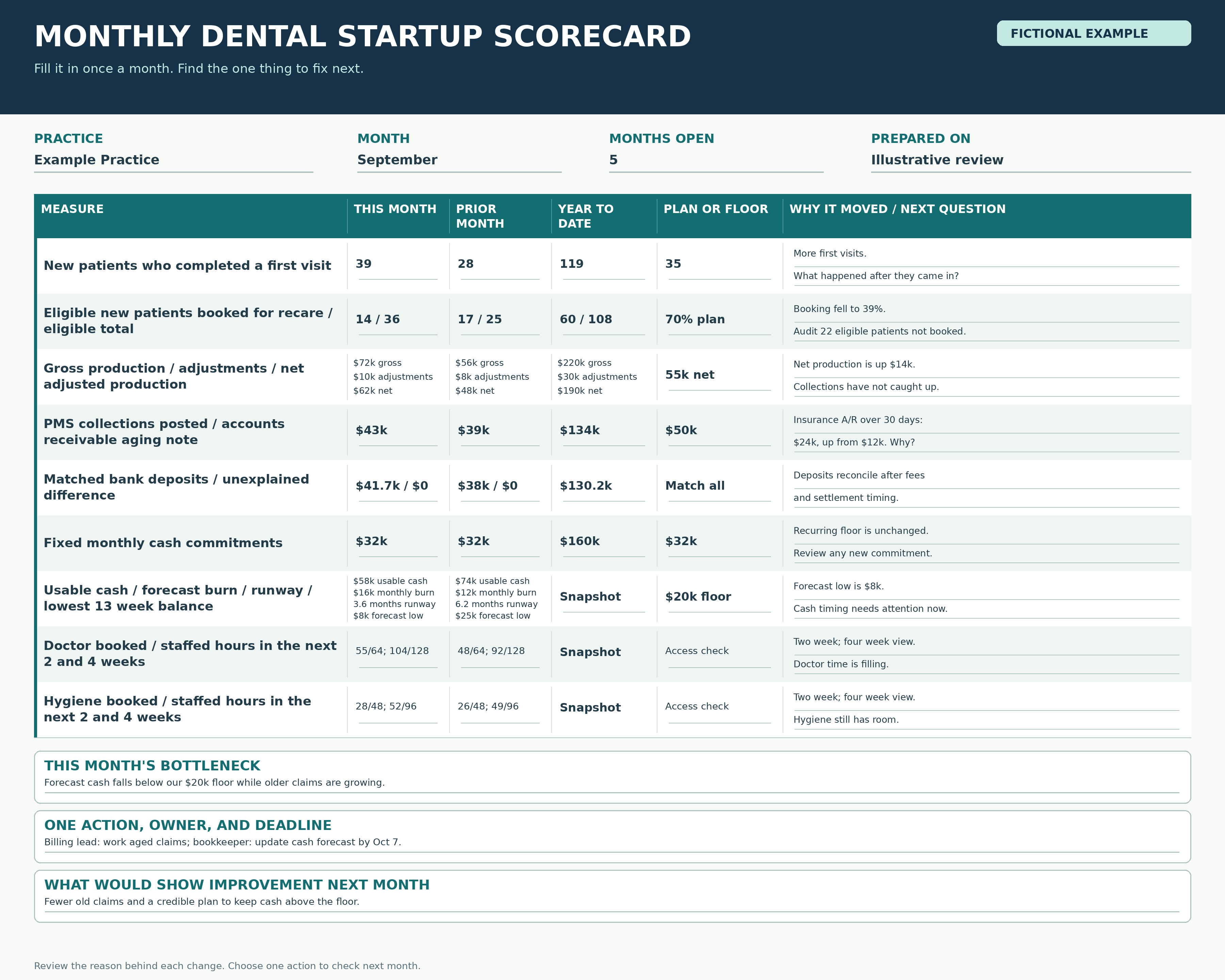
Here is a fictional September review for a practice in its fifth month. The numbers are examples, not targets for other startups.
What the owner learns from it
At first, September looks like a win. New patients rose from 28 to 39. Net adjusted production climbed from $48,000 to $62,000. The doctor’s next four weeks are filling up.
But only 14 of 36 eligible new patients booked a return visit, compared with 17 of 25 the month before. At the same time, insurance balances more than 30 days old grew from $12,000 to $24,000. Payments posted in the practice system rose only modestly, even though the team completed considerably more care.
The bank deposit row helps narrow the problem. September’s $41,700 in patient and payer deposits reconciles to posted payments after documented fees and settlement timing. The owner does not need to chase an unexplained deposit difference. The concern is that older claims are still unpaid while cash is getting tighter.
Cash on hand fell from $74,000 to $58,000. More concerning, the forecast’s lowest balance over the next 13 weeks is $8,000, below this owner’s chosen $20,000 floor. That makes payment follow-up and the cash forecast the first priority. The billing lead works the older claims by reason and follow-up date, while the bookkeeper checks when money is realistically expected to arrive. The owner reviews the forecast before adding another commitment.
The recare result still needs attention. The office manager can review the 22 eligible September patients who were not booked and report why they left without a next visit. That investigation runs alongside the urgent cash work. It gives the team a specific recare fix to choose once they know whether the issue is appointment access, the checkout handoff, patient preference, or an incorrect eligibility assumption.
That is the decision the completed scorecard makes visible: growth is happening, but cash timing needs attention first. Recare is the next problem to diagnose.
Copy and fill monthly scorecard
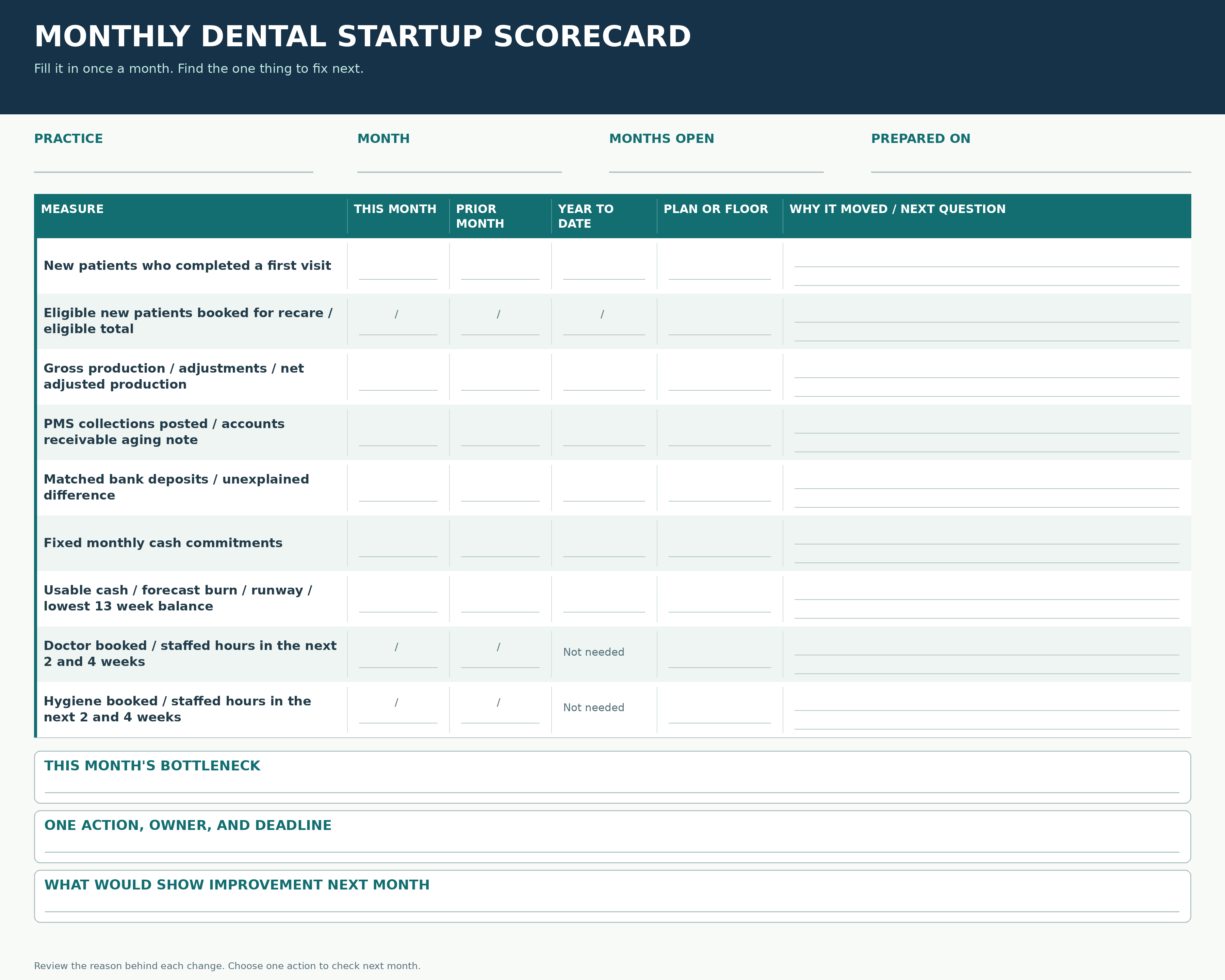
The blank scorecard is where this guide becomes useful to your practice. Fill it out once a month, preferably after you have closed the prior month’s payments and checked the bank deposits. You do not need every figure to be perfect on the first pass. You do need to know where it came from, what period it covers, and what you still need to verify.
Start with the practice name, reporting month, and months since opening. That last field gives the numbers some context. A practice in its second month is still establishing its schedule and payment flow. By month ten, you should have a clearer picture of whether patients are returning and whether the cash plan is holding up.
How to use the columns
This month is what actually happened during the calendar month, unless the measure looks forward. Schedule capacity, for example, shows the appointments booked over the next two and four weeks as of the day you prepare the scorecard. Write that date in your notes so you can compare similar snapshots later.
Prior month helps you notice movement. It does not tell you whether a change is good or bad without context. Collections might fall because fewer patients came in, or because a large insurance payment arrived just after month end. Write down which explanation you found.
Year to date is useful for figures you can add, such as new patients, production, and collections. It is less useful for a current bank balance, runway estimate, or next month’s available hours. Leave those cells blank or write “current snapshot.” Do not add three months of runway together as though they were revenue.
Plan or threshold is the expectation you set for your own practice. It might be a monthly new patient goal, a minimum cash balance, or the number of staffed hours you planned to make available. Keep the original plan visible. If you revise it, date the revision so you can see how your assumptions changed.
Reason for change and next question is the column that makes this more than a report. Write one or two specific sentences. “Production increased” repeats the number. “Production increased because we added a doctor day, but collections have not caught up yet” tells you what to check next.
What to put in each row
New patients who completed a first visit. Count people who actually came in, once each. Keep calls, bookings, cancellations, and no shows separate. If the number rose, ask where those patients came from and whether the practice had room to serve them well. If it fell, look at inquiries, appointment availability, booking, and attendance before deciding you have a marketing problem.
Eligible new patients booked for recare. Write the number booked over the number eligible. For example, the entry might read “12 / 18,” meaning 12 of 18 eligible patients have an appropriate future preventive visit scheduled. Record why someone was excluded or needed a different clinical next step. A booked visit is encouraging, but it is not a completed return. When patients become due, check whether they actually came back.
Gross production, adjustments, and net adjusted production. Keep all three visible. Gross production alone can make the month look stronger than the amount the practice expects to collect after adjustments. If net production changed, ask whether the cause was more kept appointments, more clinical hours, a different treatment mix, or one large case.
PMS collections and accounts receivable. Enter payments posted in the practice system for the month. In the note, flag old insurance claims or patient balances that need attention. Collections this month may pay for care completed in an earlier month, so do not expect them to match this month’s production exactly.
Matched bank deposits and unexplained difference. Use the collection to bank bridge to enter the patient and payer receipts you matched to bank credits. Write down any amount you still cannot explain. A documented card fee or payment that settled next month is different from an unresolved difference. The latter needs a person assigned to investigate it.
Fixed monthly cash commitments. Include the recurring payments the practice has already agreed to carry, such as occupancy, base payroll, insurance, software, and scheduled debt payments. Note any increase that is about to start. This row helps you see the cash cost of a decision before you hire, expand hours, or sign another contract.
Usable cash, forecast burn, runway, and the lowest projected balance. These belong together because a comfortable bank balance today can hide a difficult week ahead. Enter the cash genuinely available after known commitments. If the practice is using more cash than it receives, estimate how long that can continue under the current forecast. Then look at the lowest projected balance over the next 13 weeks. That low point is often more useful than the balance at the end of the forecast.
Doctor and hygiene capacity. Enter booked hours over staffed available hours for each. Keep doctor and hygiene separate. A full doctor schedule and open hygiene time suggest a different next move from two schedules with plenty of openings. In your note, mention whether patients can find suitable appointment times and whether cancellations are changing the picture.
Finish with a decision
Do not end the review after filling in the last number. Complete the three lines at the bottom.
For this month’s bottleneck, name the specific place where progress is getting stuck. “We need growth” is too broad. “New patients are coming in, but eligible patients are leaving without a return visit” gives the team something to examine.
For one action, owner, and deadline, choose a change someone can actually complete. For example: “The office manager will review the last 20 first visits, record why eligible patients left unscheduled, and bring the results to our meeting next Friday.” That is clearer than “Improve recare.”
For what would show improvement next month, decide in advance what evidence you want. It could be more eligible patients appropriately booked, fewer old claims without follow-up, a smaller unexplained deposit difference, or a safer projected cash low point. Some outcomes, such as patients actually returning for care, take longer than a month. Note the early sign now and check the final outcome when it becomes available.
This scorecard is not a pass or fail test for a young practice. It is a way to stop guessing. At the end of each monthly review, you should be able to say: “Here is what changed, here is why we think it changed, and here is the one thing we are doing about it.”
So, is your startup doing well?
You may not get a clean yes or no in the first year. The schedule will have gaps. Some payments will arrive later than you expected. A strong month will be followed by one that makes you nervous. None of that, by itself, tells you whether you are building a healthy practice.
What matters is whether you can see the full picture and respond to it. Are new patients becoming returning patients? Is the care you provide turning into money you can account for? Can you meet your commitments and make room for growth without putting the practice under more pressure than it can handle?
The scorecard will not make those decisions for you. It will show you where to look. One month, the answer might be to fix the checkout handoff. Another month, it might be to clear old claims, protect your cash, or add clinical time because patients cannot get in soon enough.
That is a much more useful answer than “We saw a lot of new patients.” You can say, “Here is what is working. Here is what is getting in the way. And here is what we are doing next.”
For more helpful tips, strategies, ideas, and marketing advice, listen to The Dental Marketer Podcast.
